Lipid metabolism
Lipids are a broad class of vital biomolecules. Together they play indispensable roles in energy storage, membrane architecture and cell signaling. However, elevated lipid concentration can pose detrimental effects leading to cell death. Such aberrant lipid biology is quite general, and contributes to metabolic disorders such as obesity and diabetes, as it has been well documented in a wide spectrum of cells and tissues. Importantly, saturated fatty acids (SFAs), but not unsaturated fatty acids (UFAs), can elicit the lipotoxicity. Mysteriously, UFAs even reverse the impairments of SFAs. Despite extensive researches into the underlying biochemical mechanisms, the biophysical basis of this aberrant lipid metabolism is largely unknown. For instance, people actually don’t know what subcellular compartments fatty acid metabolites build up in, what the structural, dynamical and functional natures of SFA-derived metabolites are, and how SFAs and UFAs are different.
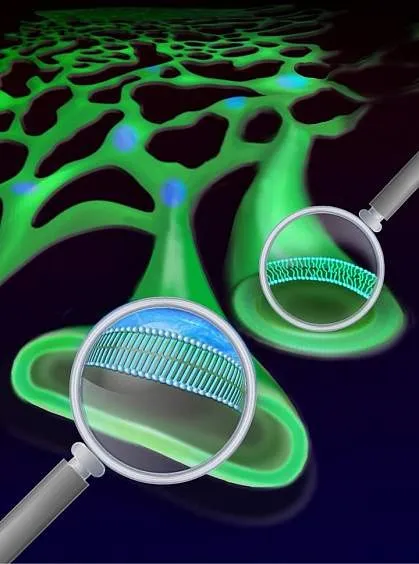
Using SRS microcopy to track the intracellular fates of deuterium-labeled lipids, we have identified previously unknown structure, dynamics and function of lipid metabolites. Surprisingly, metabolites of SFAs are found to phase segregate the endoplasmic reticulum (ER) membrane (which presumably adopts a uniform phase) in a wide range of cell types. Remarkably, the newly formed domains exhibited solid-phase membrane characteristics as detergent resistance, high conformational order, ultraslow lateral diffusion, strong intra-domain interaction and large-scale structural stability. The is the first report of solid-phase membrane in living mammalian cells to our best knowledge.
We further found that adding unsaturated fatty acids could ‘melt’ the membrane islands frozen by saturated fatty acids. This new mechanism can partly explain the beneficial effect of unsaturated fatty acids and how unsaturated fats like those from fish oil can be protective in some lipid disorders.
Y. Shen, Z. Zhao, L. Zhang, L. Shi, S. Shahriar, R. B. Chan, G. Paolo and W. Min. “Metabolic activity induces membrane phase separation in endoplasmic reticulum”, Proc. Natl. Acad. Sci. USA 114, 13394 (2017).