Optical barcoding for high-throughput identity tagging
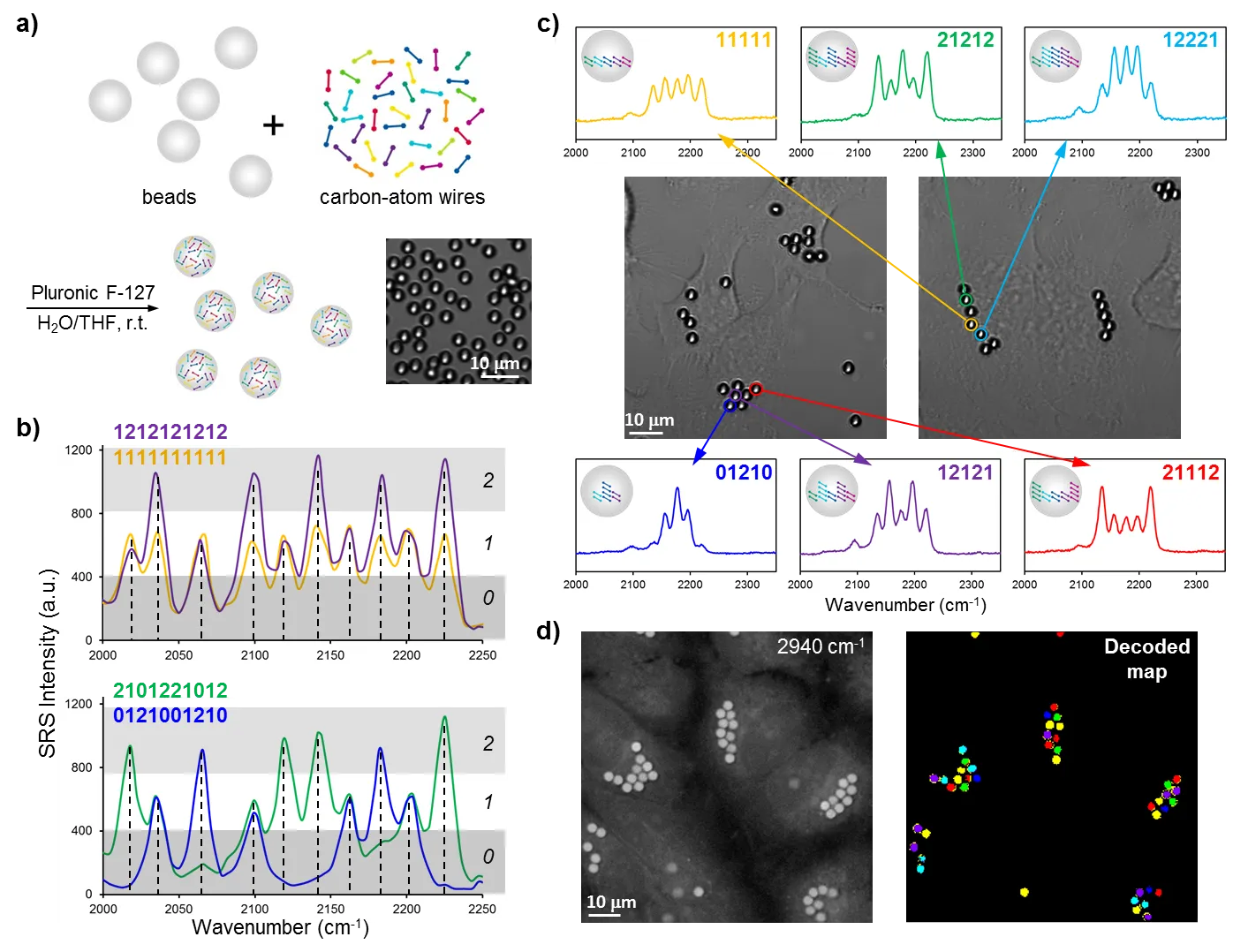
Systems biology and personalized medicine demand high-throughput analysis of cells and biomolecules such as antigens and drugs, the core technology of which often requires distinguishable barcoding. We hence applied Carbow to optical data storage and identification on microbeads. 10 resolvable frequencies at 3 distinct intensity levels (i.e., ternary digit) readily renders 310-1=59048 distinct barcodes, yielding the largest number of distinct spectral barcodes to date, whereas the literature record is around 1000.
Besides in vitro detection, barcoded beads can potentially be used as a unique ID to tag individual cell and map out the interaction of cells with time, as in the human cell atlas project (studying ~ 1013 cells). Owing to the small micron-size, multiple beads can be combined in labeling single cell. We show that HeLa cells can take up several beads containing different barcodes. The encoded information can be read out by Raman spectroscopy, allowing rapid visualization of cell identity. Hence, if using 3 encoded beads to tag each cell, we would be able to generate 59048C3=3×10¹³ IDs, sufficient to identify all cells in the human body.
F. Hu, C. Zeng, R. Long, Y. Miao, L. Wei, Q. Xu and W. Min. Super-multiplexed optical imaging and barcoding with engineered polyynes. Nature Methods (2018) in press