Super-nonlinear fluorescence microscopy
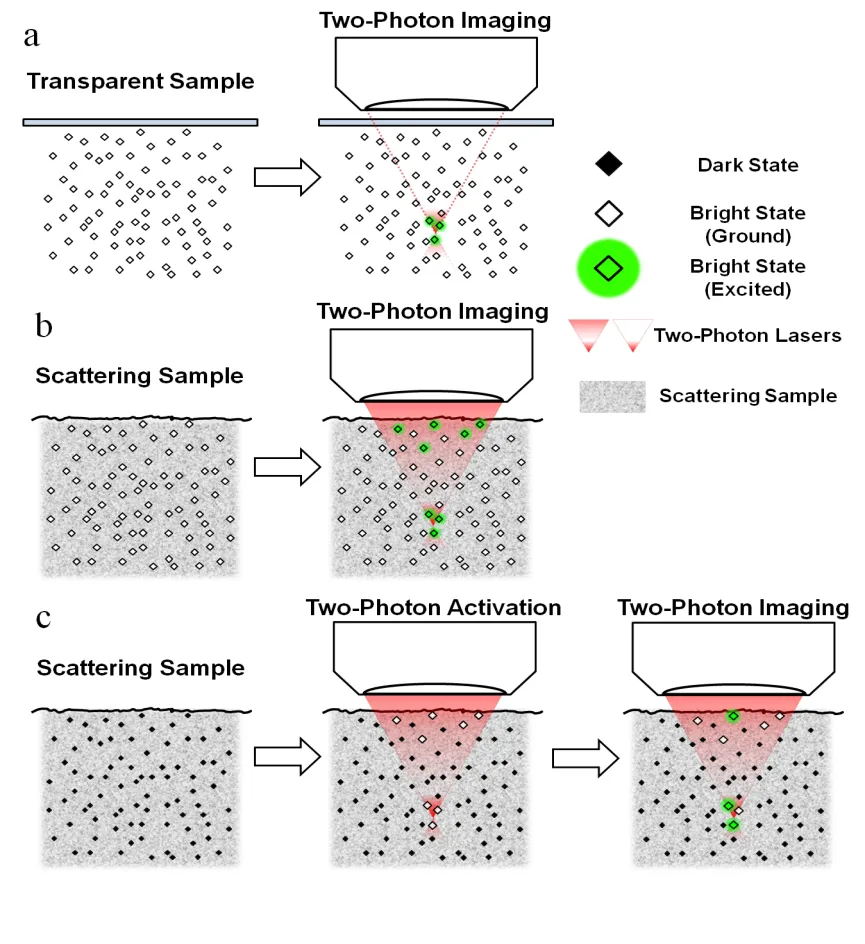
It is extremely desirable to be able to probe biological activities deep inside living organisms. Utilizing a nonlinear excitation scheme, two-photon fluorescence is the most successful optical microscopy for this endeavor. However, a fundamental imaging depth limit still exists for two-photon fluorescence microscopy when imaging highly scattering samples, accompanied by the inevitable background excitation. Essentially, the optical sectioning picture breaks down when approaching the fundamental depth limit. Quantitatively, the depth where the in-focus signal and the out-of-focus background are equal to each other is defined as the fundamental imaging-depth limit. We are interested in breaking and extending such a fundamental imaging-depth limit for ultra-deep tissue imaging.
We reason that higher order nonlinear processes should offer even tighter spatial localization of the fluorescence generation and potentially deeper penetration. To this end, we have conceived and realized a family of super-nonlinear fluorescence microscopy rendered by spectroscopic transitions including photoactivation, photoswitching, stimulated emission, ground state depletion and frustrated FRET. Conceptually, unlike conventional multiphoton processes mediated by transient virtual states, our strategy constitutes a new class of fluorescence microscopy where high-order nonlinearity is mediated by real population transfer. Practically, this class of super-nonlinear fluorescence microscopy has the prospect to image scattering samples such as brain tissues with unprecedented contrast and depth penetration.
Y.-T. Kao, X. Zhu, F. Xu and W. Min. “Focal switching of photochromic fluorescent proteins enables multiphoton microscopy with superior image contrast”, Biomed. Opt. Express 3, 1955 (2012).
Z. Chen, L. Wei, X. Zhu and W. Min. “Extending the fundamental imaging-depth limit of multi-photon microscopy by imaging with photo-activatable fluorophores”, Opt. Express 20, 18525 (2012).
X. Zhu, Y.-T. Kao and W. Min. “Molecular-switch-mediated multiphoton fluorescence microscopy with high-order nonlinearity”, J. Phys. Chem. Lett. 3, 2082 (2012).
L. Wei, Z. Chen and W. Min. “Stimulated emission reduced fluorescence microscopy: a concept for extending the fundamental depth limit of two-photon fluorescence imaging”, Biomed. Opt. Express 3, 1465 (2012).